Where the surface is the asset, the salt decision stops being about price per tonne and becomes about what the chloride does to the structure underneath.

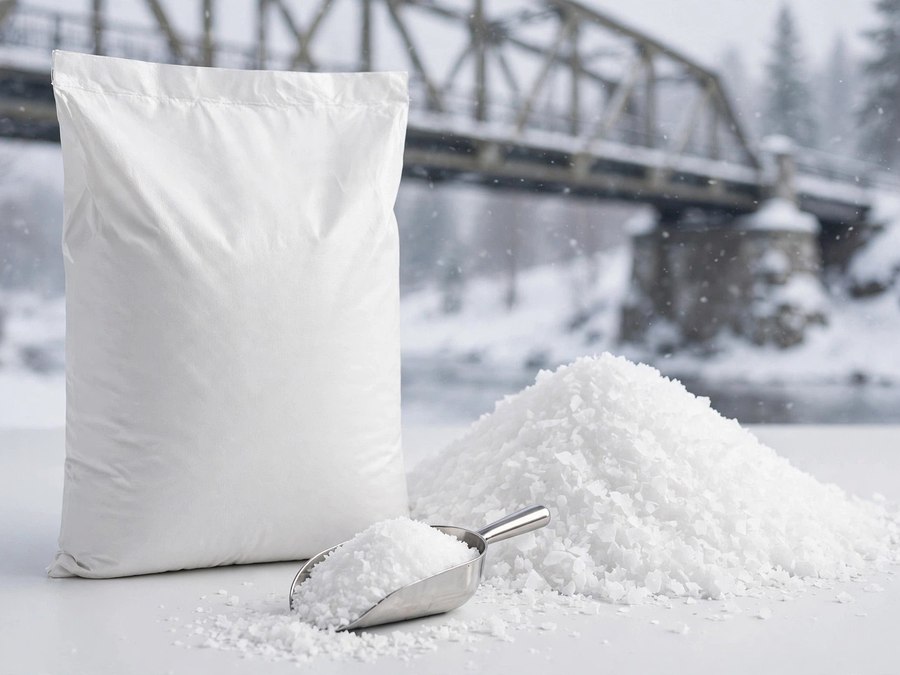
A bridge deck ices before the road leading to it, because it loses heat from both surfaces. It is also the most expensive thing the salt will touch, and the damage does not show up for years.
Airport aprons add a second constraint: the product has to work around aircraft, ground equipment and drainage that discharges somewhere specific. Neither site is buying on melting speed alone.
That is the case for a higher-magnesium, calcium-free grade with a full inhibitor package — HB-3 — and for specifying it deliberately rather than as a substitute for the network product when the network product runs out.
| Requirement | Our position |
|---|---|
| Reduced chloride aggressiveness | HB-3: 95% MgCl₂·6H₂O, no calcium component, 5% corrosion inhibitor |
| Working at low temperature | Magnesium chloride keeps working below the point where sodium chloride stops being useful |
| Packing for a site with limited storage | 25 kg bags, or 1,000 kg jumbo bags on ISPM 15 pallets |
| Traceability | Batch figures stated on the certificate that travels with the shipment |
Corrosion performance depends on the test method, the concentration and the metal being tested. We quote the composition and the inhibitor content; we do not hand out a corrosion rate from a test we did not run. If your specification has a test protocol, buy a one-tonne trial lot and run it — that is exactly what the minimum order size is for.
We answer with an FOB Qingdao price for that one item — not a catalogue. Trial lots from one tonne, around 27 tonnes per 20′ container.
We supply the product and packing. Airport procurement usually runs through a distributor or a ground-handling contractor, and often through a formal tender.
No. Aircraft de-icing and anti-icing fluids are a separate, certified product category. HB-3 is for surfaces — runways, taxiways, aprons, bridge decks.
Yes — trial lots from one tonne.